
 86 15267043800
 86 15267043800

Do You Need a New Mold? A 2027 Cost & Decision Guide for Custom Glassware
Most custom glassware projects do not start with a new mold. They start with a question: can we make this shape with what already exists?
Getting that answer right is the difference between a tooling fee of zero and a four-to-six-week delay you did not budget for. This guide explains when a new mold is genuinely required, what drives the cost, how long development takes, and how to protect your investment once the mold exists.
The three paths to custom glassware
Path 1 — Deco-only customization
The body shape already exists. You change the colour, the surface finish, the decoration, or the packaging. No new mold. Typical lead time: sample in about a week.
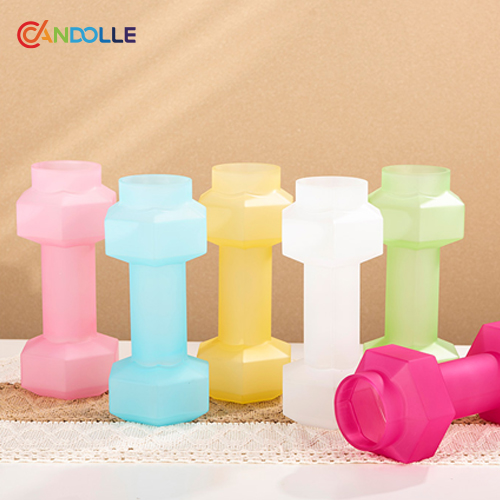
CANDOLLE Colored Dumbbell-Shaped Glass Vase/Tumbler: This versatile vessel is a custom iteration of the standard transparent "dumbbell" vase. It is available in six all-new colors and features a frosted finish, a departure from the smooth surface of the original. The diverse color palette enhances its decorative appeal and versatility in styling; it functions perfectly as a home decor vase or an everyday drinking glass, while the frosted texture makes it especially well-suited for use during exercise or outdoor activities.
Path 2 — Modification of an existing mold
You want a different height or capacity on a shape that already runs. In some cases, the existing mold can be adjusted rather than replaced; in others, a new cavity is required. We hold 1,000+ ready molds precisely so this conversation can happen quickly.
Path 3 — Full new mold
A genuinely new silhouette: an egg-shaped stemless goblet, a twisted carafe, a custom-ribbed candle vessel. This is where tooling cost and development time appear.
Rule of thumb: roughly three out of four first enquiries we receive can launch from Path 1 or Path 2. Why not take just one minute to ask whether we already have a certain shape before you accept a tooling quote?
What actually drives mold cost
Mold cost is not a single line item. It is the sum of decisions you make in the drawing:
| Cost driver | Why it matters |
| Number of cavities | More cavities = higher mold cost, lower unit cost at volume |
| Silhouette complexity | Curves, asymmetric shapes, sharp transitions |
| Surface texture | Ribs, flutes, swirls, diamond patterns require precise engraving |
| Dimensional tolerance | Tight tolerances on mouth diameter or base thickness add machining time |
| Material of the mold | Cast iron vs. other tooling materials affects heat behaviour and life |
| Sample rounds | Each trial blow costs time; a two-round project is cheaper than a four-round project |
| Colour and finish testing | Matching a target colour or a matte sandblast finish may need dedicated trials |
This is why a responsible factory will not quote a mold over email from a single photo. Ask for a written breakdown: mold fee, sample fee, and the amortization policy.
How the tooling fee is amortized
The mechanic is simple. If the mold fee is M and your first production order is N pieces, the tooling adds M ÷ N to every piece. The same mold fee is five times heavier on a 1,000-piece order than on a 5,000-piece order.
Three commercial models exist in practice:
One-off fee
You pay the mold fee; the mold is used for your orders.
Amortized into unit price
The fee is spread across an agreed volume. Ask what happens if you reorder less than projected.
Tooling Fee Credit Based on Cumulative Order Volume
For selected custom glassware projects, we offer a tooling fee credit policy based on cumulative order volume. Once purchases of the same product reach an agreed quantity, part or all of the initial mold fee can be credited against subsequent orders.
This approach allows buyers to spread their initial investment across multiple production runs, making custom designs more cost-effective as order volume grows.
The qualifying quantity, credit amount, and applicable order terms are agreed upon before production, giving both parties a clear and transparent cost structure.
Whatever the model, put three things in writing: who owns the mold, who may use it, and how long it is kept.
Development timeline: what 5–7 days and 10–15 days actually mean
Standard molds are typically developed in 5–7 days; complex ones take 10–15 days. "Complex" usually means at least one of the following:
non-rotational or asymmetric geometry
double-layer or thick-wall construction
fine surface texture (fine ribs, tight swirl pitch)
unusual mouth diameter or an angled spout
The clock does not stop at the mold. Budget the full chain: drawing review → mold making → first trial blow → sample to you → revisions → confirmation → production. Samples are generally ready 7–10 days after drawings are approved.
Practical advice: lock the drawing first. Every change after the mold is cut is a revision, and revisions are where schedules actually slip.
Protecting your tooling investment
Mold ownership clause. State that the mold is your property (or is dedicated to you) and cannot be used for third parties without written consent.
Exclusivity window. A common and reasonable ask: the shape is not offered to other buyers in your market for 12–24 months.
Mold custody. Confirm where the mold is stored, who maintains it, and what happens if the mould needs repair.
Volume protection. If you paid a one-off fee, ask for a unit price that is not adjusted upward in the following two orders.
Exit terms. If you change suppliers, can the mold be transferred? Some factories allow it; some do not. Ask before you pay.
A five-question checklist before you approve tooling
Can this be made with an existing mold? Please show me the closest two or three.
What is the mold fee, and what exactly does it include?
How many sample rounds do you expect, and who pays for rounds two and three?
How is the fee amortized, and what if my reorder volume is lower than planned?
Who owns the mold, and is the shape exclusive to me?
Print these five questions and put them in your RFQ. A factory that answers them in writing in one email is a factory worth continuing with.
FAQ
How long does a new glass mold take?
Typically 5–7 days for a standard mold and 10–15 days for a complex one, followed by 7–10 days for samples. Add shipping time to your market.
Can I avoid tooling cost entirely?
Often yes — by customizing colour, finish, decoration, or packaging on an existing shape. Ask to see the existing mold library first.
Is the mold mine if I pay for it?
Only if you make it contractual; specify ownership, exclusivity, custody, and transfer conditions in the purchase agreement.
Does a more expensive mold mean better glassware?
Not directly. Cost reflects geometry and tolerance, not quality. Quality shows up in raw material, colour consistency, and polishing — three things you should verify on samples, not on a price sheet.
Next step:
Send us your drawing, reference photo, or target capacity. We will tell you honestly whether you need a new mold — and if you do, we will quote mold, trial, and sample fees in writing within 24 hours.
Get a mold quote in 24h → Contact Link